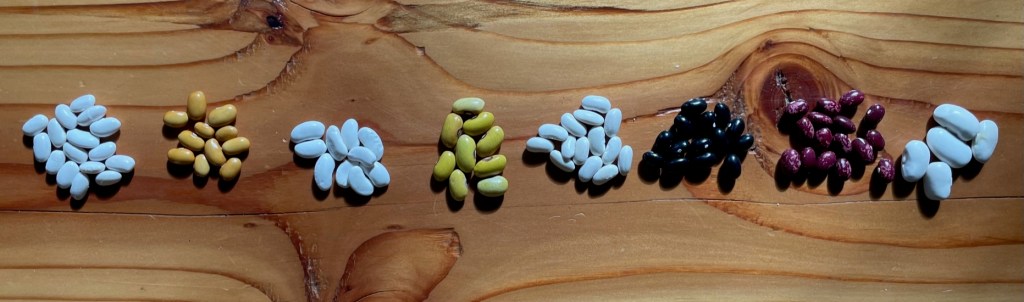
We grew out eight of our dry bean varieties this summer and between the good weather and giving them a head start by transplanting for the first time we actually got them in earlier than ever. It still took me a while to get to cleaning them and then to bring them to the farm but at this point we’ve been selling a few varieties at a time at the farm stand for a few weeks now and I figured it was time to make a post with more description of each variety. I’ll list them below in order from right to left in the photo above.
At the bottom I’ll describe the two corn varieties that we grew with the beans (and have been growing for many years now). We’ll be giving out the popcorn soon and if we have any extra we’ll sell that on the farm stand. As usual we’ll have a hand cranked grinder at the farm in December for folks who want to grind their own polenta from our polenta variety (weather permitting).
Dry beans in general: If you’ve only ever had canned dry beans, or beans from the bulk section, these are a completely different experience. They are cook easily and evenly and have an extra layer of flavor. In general these all have delicate skins and cook well by soaking overnight, bringing to a boil and the gently simmering for as little as 20 minutes, although as they get they’ll take a bit longer, maybe 45 minutes to an hour. Add salt and other seasoning to taste, generally about 1-2 teaspoons of salt per bag. Alternatively I really like to use the residual heat from baking in my oven to cook the beans gently by putting them in a covered, heatproof container and baking them instead of cooking them on the stove top – same directions otherwise. Be sure to save the cooking liquid which is delicious. Variety descriptions follow…
Nico Cannellini these are the one bean I haven’t cooked with much! They were brought to me as a gift from a farmer in Tuscany a few years ago and I’ve been slowly increasing the amount I’ve been growing. This is the same farmer who I got the polenta corn from and I don’t know if there’s really a variety name, but I’ve just named the beans after his farm, Agricola Biologica Nico. On a side note, the Pescia and Piattella white beans we grow are also cannellini types, but each is distinct in size and shape, with subtle flavor differences.
Swedish brown is a bean I’ve been growing for so long I don’t even remember where I got it or why. I’ve probably been growing it for 25 years now and I just really like the flavor. It’s a bit like a pinto bean, but so much more flavorful.
Piattella I got this one from a grower in Italy who also uses corn for trellising. It’s a Slow Food Ark variety and you might try to find it from the Italian growers if you really like it and support their efforts to keep it growing in it’s traditional areas.
Yellow Forest (Giele Wâldbeantsje) This is another Slow Food Ark variety. It’s from the Netherlands and does pretty well here. Flavor wise it’s similar to the Swedish Brown beans but it’s much larger. As these beans age in storage their color changes from light yellow to a darker yellow, and there’s some variation even when they are newly dried.
Pescia (Sorana) A great little white bean, very tender and tasty. Lane Selman and I brought this back from Italy by request for Uprising Seeds in 2014 and they shared seeds from their first grow out with me the following year. I’ve been growing it since then and it’s a favorite for its great flavor and early drying on the vine. It’s a Slow Food Ark and Presidium variety under the name Sorana and you might try to find it from the Italian growers if you really like it and support their efforts to keep it growing in its traditional areas. Uprising has calls it Pescia, after the area where it is grown, as the Sorana name is protected and should only be used by growers in the protected area.
Tolosaka This is my name for the tolosa black bean, which I’ve been growing since 2007. This is a beautiful, large, deeply black bean that is from the Basque region of Spain. Look it up, apparently it’s famous. I just know it’s delicious and one of my favorites.
Red Forest (Reade Krobbe) Another Dutch Slow Food Arc variety. As with all of these beans I just like eating these by themselves, but they’re also very good in soups as they hold their shape well. I’ve also made red bean paste with them for sweets.
White Runner (Katherine’s) All of the other beans we grow are Phaseolus vulgaris, but these are Phaseolus coccineus. They are related to the more common Scarlet Runner beans but have white flowers and beans. As with all runner beans I’ve had they are very large with delicious meaty interiors and incredibly delicate skins when cooked. My friend Katherine Deumling was my original source for this variety and a neighbor of her family in Salem was the grower. I don’t remember the variety name, just that I got them from her and that they grow better for me than the better known Corona White Runner bean – which is even larger, but doesn’t ripen well here (even these runner beans are a little marginal and tend to mature a bit late).
Dakota Black Popcorn pops bright white and with great fresh popcorn flavor, not at all like the big stale stuff you get in most bulk bins. If you have a grinder that will grind hard corn it makes a good addition to pancakes and bread (popcorn is very hard and many grinders aren’t strong enough to grind it).
Otto File Polenta Corn A number of years ago I was in Italy and visited a wonderful little biodyanamic market farm in Lucca. The farmer gave me an ear of his golden polenta corn (otto file, meaning eight rows in english – because there are eight rows of kernels on the slender cobs). I ended up planting it in my garden and it made amazing polenta – tons of corn flavor, beautiful golden color, slightly sweet – so I grew more. We use a relatively inexpensive Corona hand cranked grist mill to grind it into polenta, but there are many other options out there (these mills will also grind popcorn). It can also be cooked whole. It does not make good nixtamal in my opinion – very gummy.
 Cully Neighborhood Farm